
Research Team:
Phoebe Eggleton (PhD Candidate)
Malcolm Campbell (Main supervisor – UoC)
Matt Hobbs (Secondary supervisor – UoC)
Joseph Boden (Supervisor – Christchurch Health and Development Study)
Funding
UC Aho Hīnātore | UC Accelerator Scholarship
Duration
2022-2024
Project summary
This project is a Ph.D. thesis by publication which investigates exposure to the Canterbury Earthquake Sequence (2010-11) and the associated physical health outcomes. The project uses data from the Christchurch Health and Development Study, a birth-cohort which started in mid-1977 with 1,265 individuals born in the Christchurch urban area. This cohort has been studied over the course of 40 years on a number of topics such as health, education and life progress.
The Canterbury earthquake sequence began in 2010 with a major earthquake situated in Darfield, Canterbury. A series of aftershocks struck Canterbury the following year in 2011, with the most notable event on the 22nd February. Just over half of the Christchurch Health and Development Study cohort members were in Canterbury at the time of one or more of the major earthquakes. The thesis provides a distinct opportunity to use longitudinal data to assess the impact of the earthquake sequence.
The thesis is split into three key ideas. The first published article investigates the spatial location of people during the time of the February 2011 major earthquake. This article shows that by using a residential address as a measure of exposure alone, important information about exact exposures at the time of the event are missing.
The second topic investigates exposure to the earthquake sequence and cardiovascular disease at age 40. Findings from this study show no significant association between exposure and cardiovascular disease six years after the event.
The third topic investigates severity of exposure to the earthquake sequence and long-term body weight changes. Specifically focused on body mass index and waist circumference, this article found a dose-response relationship evident by severity of exposure for increases in waist circumference.
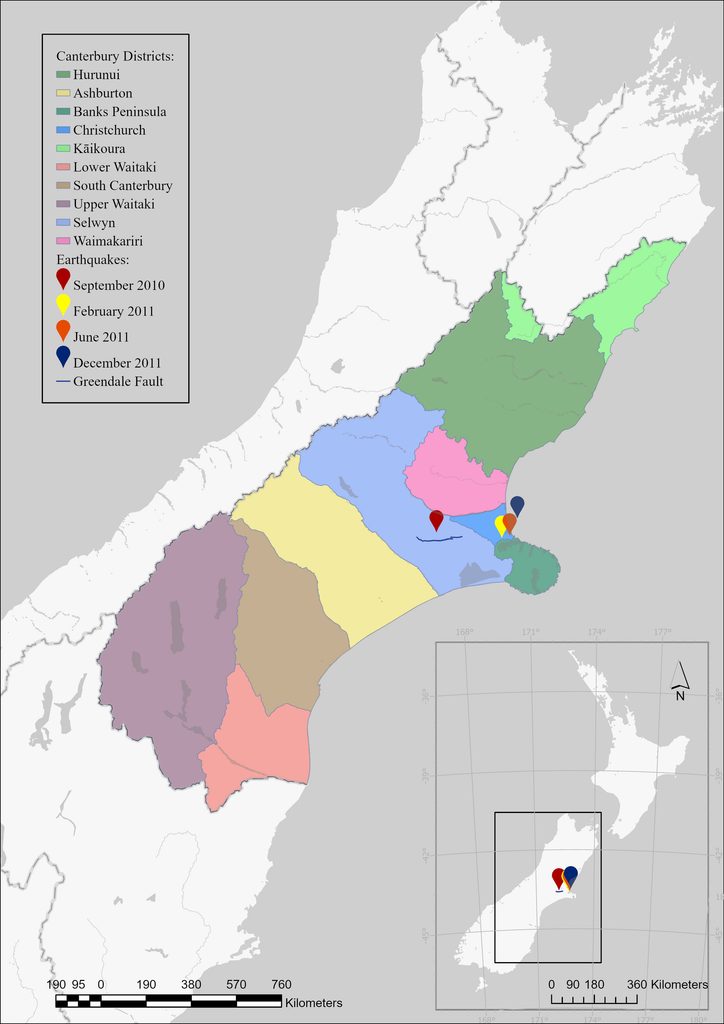
The epicentre of the four major earthquakes which made up the Canterbury earthquake sequence (2010-11) located on the map. The Greendale Fault line which previously went unknown is shown.
Outputs
Eggleton, P., Campbell, M., Hobbs, M., McLeod G. and Boden, J. Defining exposure to the Canterbury Earthquake Sequence (2010-11): a spatio-temporal birth cohort study. Places and health: data needs and analysis techniques. Institute of Australian Geographers Conference. Perth, Australia, July 5, 2023.
Eggleton, P., Hobbs, M., Deng, B., Boden, J., McLeod, GFH, Kindon, A., Campbell M. (2024, November 7-8). Investigating the association between exposure to a major earthquake and cardiovascular disease at six-year follow up: a prospective birth cohort study [Conference presentation]. Regional Studies Association Winter Conference, London, United Kingdom.
Eggleton, P., Boden, J., Harvet, A., Deng, B., McLeod, G., Campbell, M., Hobbs, M. (2025) Investigating the long-term impact of experiencing a major disaster in mid-adulthood on body mass index and waist circumference: A prospective birth cohort study. SSM – Population Health. 30:101781. https://doi.org/10.1016/j.ssmph.2025.101781