PhD Student
David Pedley (SoF- GRI)
Supervisors
Dr Justin Morgenroth (UoC)
Dr Grant Pearse (Flinders University)
Mijam Schindler (Victoria University)
Funding
GRI Scholarship and UC Doctoral Scholarship
Project summary
Achieving a sustainable city requires balancing two essential elements: housing and urban trees. The provision of high-quality and affordable housing is necessary to enable occupation by a diversity of residents who contribute to urban vitality. However, without urban trees, would that be a city where people want to live? Urban trees are the epitome of a nature-based solution, providing a wealth of ecosystem services that enhance the liveability of urban areas. The critical sustainability challenge that this project addressed is how to retain the benefits of urban trees within the pressures of intensifying cities.
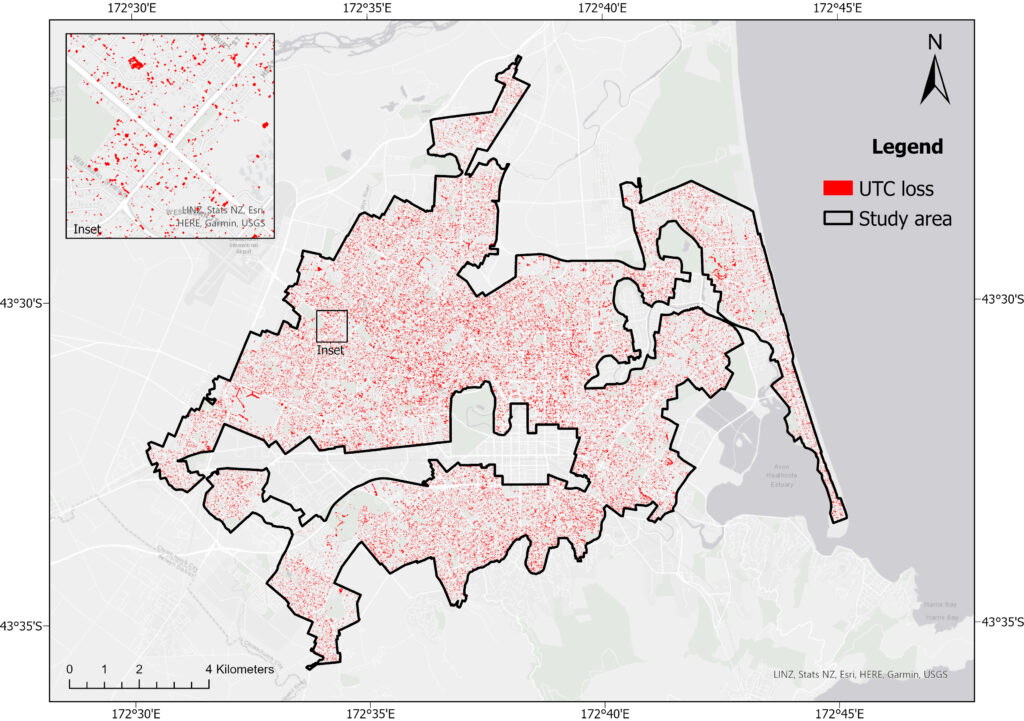
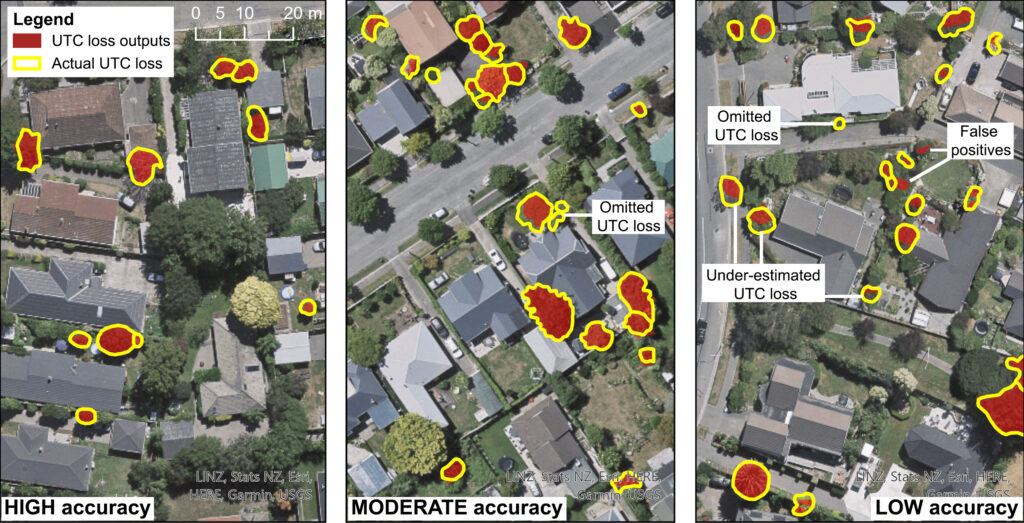
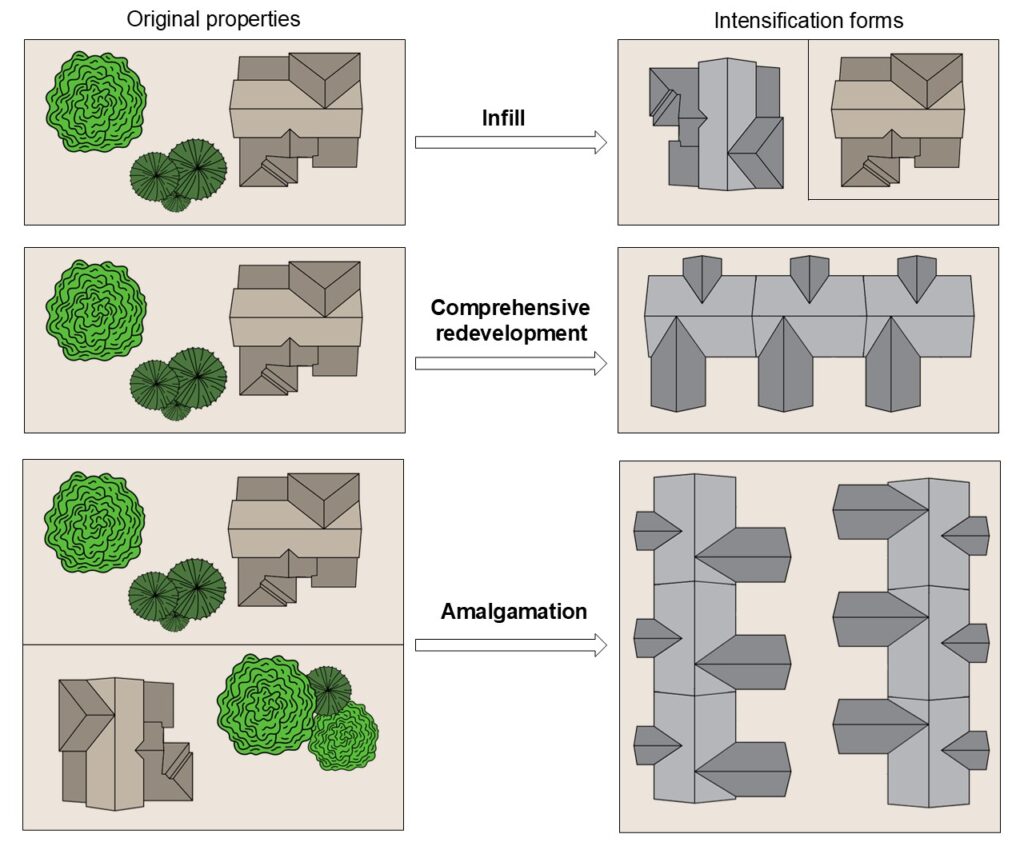
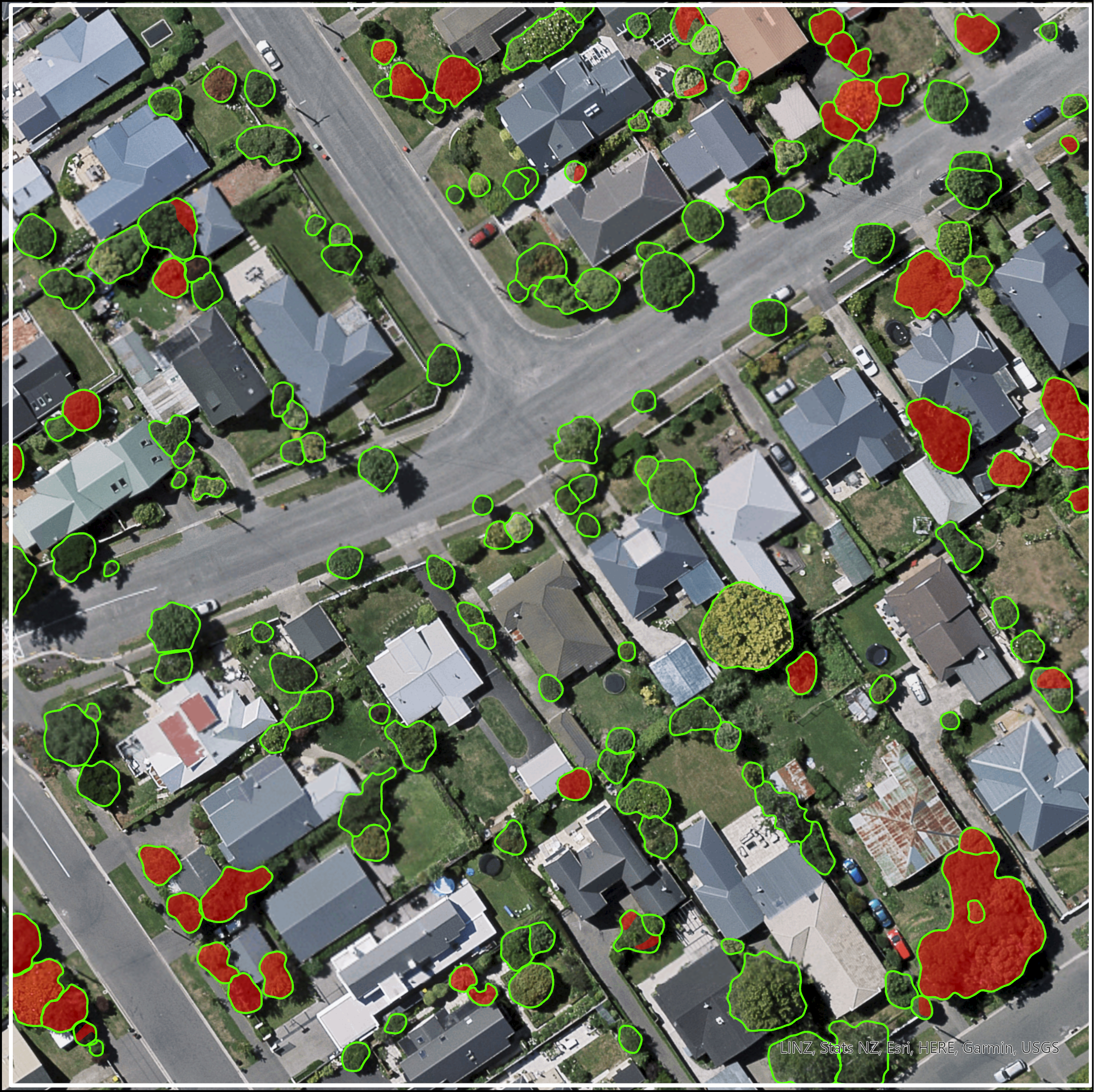
To investigate this critical tension, this study focused on housing intensification as a key form of redevelopment within compact cities. Due to its higher density nature, housing intensification presents a potential conflict with existing urban trees on private land that compete for valuable real estate. This research examined the nature and scale of this conflict by using a novel combination of high resolution aerial imagery, LiDAR, and deep learning to map tree canopy loss at the property scale across Christchurch, New Zealand over a five-year period (2016-2021). Comparing this loss to verified residential building consent data revealed important findings, including the significant relationship between intensification and tree canopy loss, the variable impact of different intensification forms, and the large proportion of loss that occurred on properties that were not redeveloped. To complement and deepen these empirical findings, online surveys and interviews were used to gather perspectives from key stakeholders that influence change, including property developers and local government. While these perspectives highlighted some commonalities, they also revealed mismatched priorities and preferences that reflect the site-specific financial objectives of property developers and the wider public responsibilities of local government. This tension affects the potential value and viability of regulation and incentives for the retention and replanting of trees during housing intensification projects.
These findings have important implications for policy makers seeking to balance the two critical objectives of housing and urban trees. Although the conflict is real and should not be ignored, oversimplification of the issue risks masking potential solutions. By combining clear regulatory strategies with cost-neutral non-regulatory alternatives, opportunities exist to focus on forms of intensification that achieve housing priorities, whilst supporting improved outcomes for urban trees. While some trade-offs are inevitable, the insights provided by this study help to support more proactive and balanced integration of housing intensification and urban trees within growing cities. The final thesis was submitted in December 2025.
Outputs:
Pedley, D., & Morgenroth, J. (2025). Detecting and measuring fine-scale urban tree canopy loss with deep learning and remote sensing. ISPRS Open Journal of Photogrammetry and Remote Sensing, 100082. https://doi.org/10.1016/j.ophoto.2025.100082
Pedley, D., & Morgenroth, J. (2025). Green vs growth: The effect of residential intensification on urban tree canopy loss in Christchurch, New Zealand. Sustainable Cities and Society, 106678. https://doi.org/10.1016/j.scs.2025.106678